
Learn about Climate Action London’s 2026 Candidate Questionnaire, Responses, Election Resources and more.
Climate and Environmental concerns and solutions are part of an overall integrated community plan and good governance for municipalities. They are multi-solving and have many co-benefits. Most City of London issues are interdependent and should not be siloed or address as one-offs.
When: October 26,2026
10am - 8pm
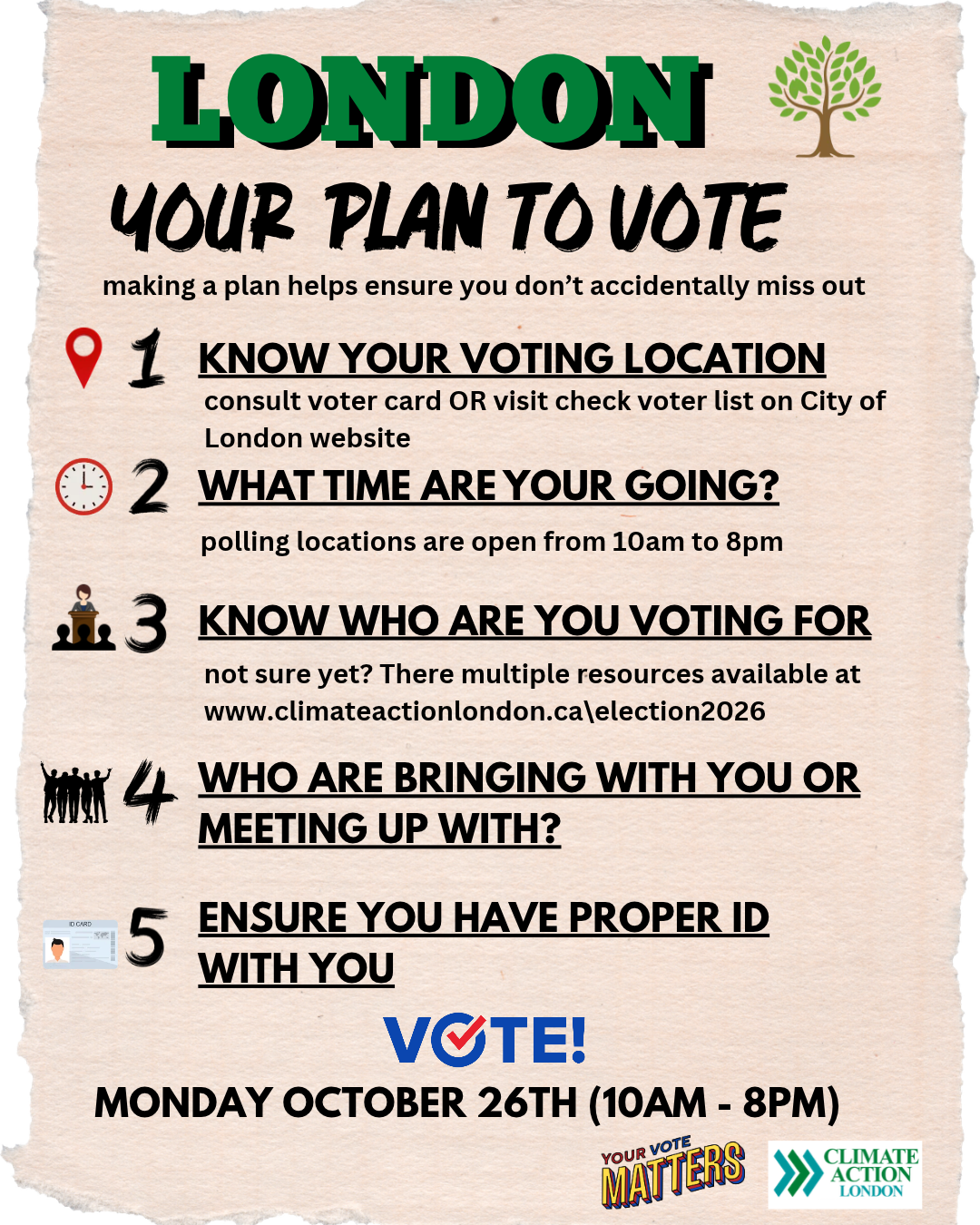
On Election Day you need to vote at your voting place indicated on your Voter Card
Where to vote:
What to bring:
Identification is required. Bring voter card + 1 of
Ontario Drivers License,
Ontario Photo Card,
Ontario Motor Vehicle Permit (Plate portion),
a mortgage, lease or rental agreement, insurance policy
utility bill for hydro, water, gas, telephone or cable TV

No Voter Card:
See full details on City of London website
Identification is required when you vote. You will need to show ID which contains your name and address. You may have to show two pieces of ID to accomplish this.
Please bring an original, or certified/notarized copy, of any of the following documents:
Ontario driver’s licence
Ontario Health Card (photo card)
Ontario Photo Card
Ontario motor vehicle permit (vehicle portion)
cancelled personalized cheque
mortgage statement, lease or rental agreement relating to property in Ontario
insurance policy or insurance statement
loan agreement or other financial agreement with a financial institution
document issued or certified by a court in Ontario
any other document from the government of Canada, Ontario or a municipality in Ontario or from an agency or such a government
any document from a Band Council in Ontario established under the Indian Act (Canada)
income tax assessment notice
child tax benefit statement
statement of employment insurance benefits paid T4E
statement of old age security T4A (OAS)
statement of Canada Pension Plan benefits T4A (P)
Canada Pension Plan statement of contributions
statement of direct deposit for Ontario Works
statement of direct deposit for Ontario Disability Support Program
Workplace Safety and Insurance Board statement of benefits T5007
property tax assessment
credit card statement, bank account statement, or RRSP, RRIF, RHOSP or T5 statement
CNIB Card or a card from another registered charitable organization that provides services to persons with disabilities
hospital card or record
document showing campus residence, issued by the office or officials responsible for student residence at a post-secondary institution
document showing residence at a long-term care home under the Long-Term Care Homes Act, 2007, issued by the Administrator for the home
utility bill for hydro, water, gas, telephone or cable TV or a bill from a public utilities commission
cheque stub, T4 statement or pay receipt issued by an employer
transcript or report card from a post-secondary school
You can check location via the Voters List Information on the City of London website. Even if you don’t appear here you can still vote by going to your nearest polling location.
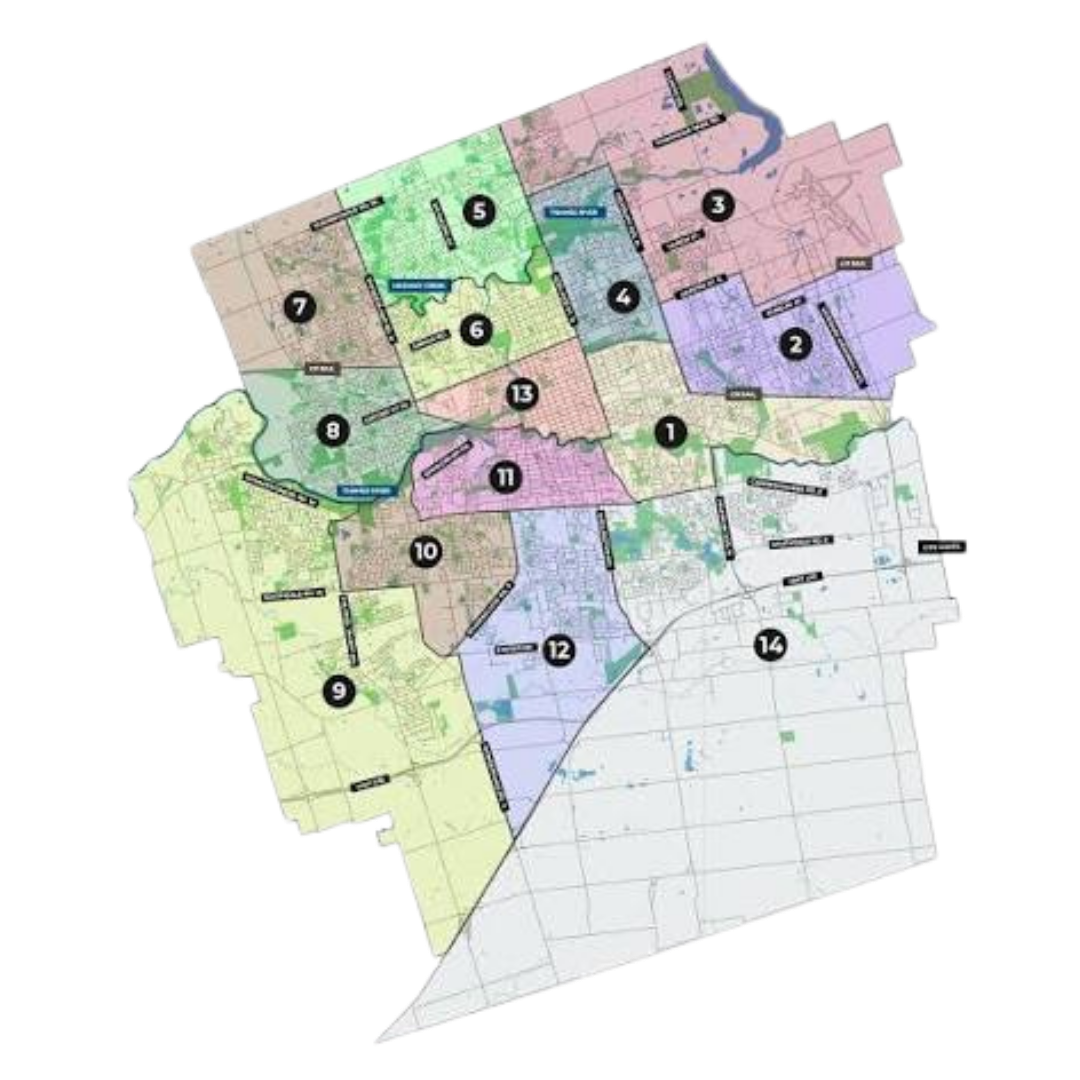
Ward Maps have been updated since the last election so be sure to check out how to check your Ward below
Read the Candidate Responses
For each question (statement) the candidate ranks whether they strongly disagree, slightly disagree, neither agrees or disagrees, slightly agrees, strongly agrees. They can also add comments about the issue or further explain their position. We also list which candidates did NOT respond to our questionnaire. Emails to candidates were initially sent August 7th with a September 1st deadline. As further candidates declared during August, emails were sent out as they appeared on the City of London website. The form for responses was kept open until September 4th to allow additional time for candidates.
Climate Action London Questions
and why we asked them
We structure our questions in a couple of ways. First, we include enough specifics to avoid generic answers where it seems almost everyone agrees. Secondly, we try to frame current issues in a way that reveals the candidate’s vision for the future of the City. A strong candidate on Climate and Sustainability may only slightly agree but provide comments of an alternative vision that addresses the underlying issue.
Improved London Transit Service
It is a priority to improve London Transit service by having 15 minute service frequency during peak weekday hours (maximum headway) on all main arterial routes while maintaining 10 minute service frequency on Rapid Transit routes. 15 minute service frequency is comparable to service in cities like Halifax and Kitchener-Waterloo. Additionally, London Transit should work to eliminate neighbourhood gaps where residents are not within 400m walking distance of a regularly service bus stop.
-
There are many co-benefits to improved transit - emissions, equity, economic - getting employees to work. While the first parts of the Rapid Transit are starting to be operational, adequate service relies on an entire network. London has intensified with many higher density buildings but to date has failed to provide adequate mobility options other than the car. This will only lead to further car congestion. Public transit is a primary solution that can provide affordable options if it is efficient. It will also benefits those who continue to use their cars as congestion will be lessened. This issue is magnified as the City of London’s population continues to grow.
Affordable Housing Targets
It is a high priority that the City of London meet the goal in the London Plan that 25% of new housing, in aggregate, (and 40% for secondary plans) is affordable to low- and moderate-income households. London has been falling short on this goal therefore it should commit to all means available to the City to increase the number of new affordable units including leverage of public lands, financial incentives to developers by reducing fees, expedited approval timelines and concierge service team for affordable developments and use of the Canada Housing catalogue of pre-approved designs. Additionally, the City should prevent private developers from turning affordable rental units into expensive ones.
-
Affordable housing has co-benefits of addressing social equity, prevents urban sprawl, and supports economic stability. Without it, lower-income residents face displacement, long vehicle commutes that increase carbon emissions, and severe financial stress that undermines long-term community resilience. True affordable housing located within walking distance of efficient public transit can be a foundation of sustainability. A solid plan and initiatives are required to turn the tide against the business as usual approach of building primarily expensive single-family housing in sprawl.
Climate Change Reserve Fund
It is important to restore funding to the Climate Change Reserve Fund to $1m per year, as it was when it was initially created and only use the funds for genuine expenses related to mitigation and adaptation projects designed to increase London’s resilience to the increasing impacts of the Climate Emergency.
-
The purpose of a climate change reserve fund is to fund capital and operating expenditures tied to the Climate Emergency Action Plan (CEAP). It can be used to back short-term pilot projects before transitioning successful programs into permanent municipal budgets or run by community groups or businesses. Many mitigation or adaptation projects in fact save the City of London money. Council has recently used some of the funds for increase grass mowing, garbage pickup, and park washroom access. While these issues may be worthy of support, they do not address the Climate Emergency by making the City more resilient or reduce emissions and should come from other areas of the budget. This question focuses on whether the candidate supports climate action within the budget.
More Aggressive Mode Share Targets (walking, cycling, transit)
The City of London should establish more aggressive 2050 mode share targets when they are next reviewed in 2028. it is important that the City move toward more daily trips by walking, cycling and transit given an increasing population, London’s GHG emissions slightly increasing and drastically missing CEAP targets and an increasing number of High Density and Medium Density residential buildings. It makes life more affordable for all Londoners.
-
The current 2050 mode share target of 32.5% (walking, transit or cycling) were set by council by selecting a target lower than what was staff recommended (which was lower than public feedback was asking for). The mean would mean that by 2050 65% of trips would still be in a personal vehicle (either single occupant or passenger. A higher mode share target would be consistent with intensification, sustainability and a growing city. Walkable neighbourhoods also reduce personal vehicle trips. This question addresses whether a candidate views climate action, and intensification in a consistent manner with how Londoners move around the City. An inconsistent approach might be supporting intensification and taller residential buildings but not significantly addresses how car dependent London currently is by more aggressively planning for viable options to car travel.
Adhere to building height maximums as per the London Plan
Building height maximums as specified in the London Plan should be strictly adhered to as they represent comprehensive plans for the growth of the city taking into account utility demands, emergency services, mobility plans, and preserving neighbourhood character. Recently, council has been approving many developments that exceed both maximum heights and densities as per the London Plan. Given that place types such as downtown, transit villages and corridors and urban corridors already allow significant building heights to meet housing supply demands and intensification targets, individual exceptions should not be allowed but changes to these height and density maximums should only be addressed through official plan amendments.
-
We believe in the London Plan concept of building up rather than out. There many climate and environment harms with (horizontal) sprawl. There is also the concept of vertical sprawl where it creates social bitterness and decreases diversity. Taller buildings tend not to be affordable once they are above a certain number of floors. They can also drastically alter the experience for existing residents of the neighbourhood. Ad hoc case by case exceptions to building heights being granted, especially when going against planning staff recommendations, seems to be a patch work approach rather than adhering to a well thought out plan. Do they agree that intensification will not be politically sustainable without addressing liveability and human scale development? We are interested in the candidate’s vision for a sustainable city while favouring intensification over sprawl. For additional reading see Jane Jacob’s view of vertical sprawl and how top-down planning projects if not carefully considered can ruin streetscapes and create a monoculture of high rises.
Mandatory Lobbyist Registry
The City of London should implement a mandatory lobbyist registry. It would help promote public trust, prevent conflicts of interest and ensure fair access. Over 15 Ontario municipalities have mandatory lobbyist registries, many of which have low cost solutions. For example Guelph has implemented a solution costing less than $25,000 per year.
-
There have been questions raised about the outsized influence of land speculators, developers and other corporate interests in the decisions being made. Many residents, not just community groups, have concerns over local governance, transparency, and accountability. Based on other municipalities a reasonably priced lobbyist registry that follows reasonable and widely adopted guidelines and policies could be put in place to start to address these concerns. This is a general good governance type question.
Moratorium on AI Data Centres
The City of London should implement a 1-2 year moratorium on AI Data Centres. There are many harmful aspects to AI Data Centres such as straining local energy grids, constant industrial level noise, heat island impacts over 2 degrees potential up to 10kms away, high water usage or other potential negative environmental impacts from maintaining closed loop cooling systems. AI Data Centres also provide very few jobs after construction. A moratorium would allow proper higher level government regulation and standards to be created before putting London residents at risk.
-
Mississauga recently passed a moratorium of AI Data Centres and other municipalities across Canada are currently considering them. Although there are no current plans for an AI Data Centre in London (there is a cloud solutions data centre on Green Valley Road), we believe a moratorium will protect London residents and signal to the high level governments stringent regulation is required on AI Data Centres. London can still be seen as business friendly to companies that wish to locate in London and creates benefits to Londoners. This question looks to determine if candidates prioritize marginal short-term jobs over the financial and environmental sustainability of the City.
Other Resources